
Determining Viscoelastic Behaviour in Sweet Potato (Ipomoea batatas L.) Tissue
Keywords:
sweet potato, viscoelasticity, stress relaxationAbstract
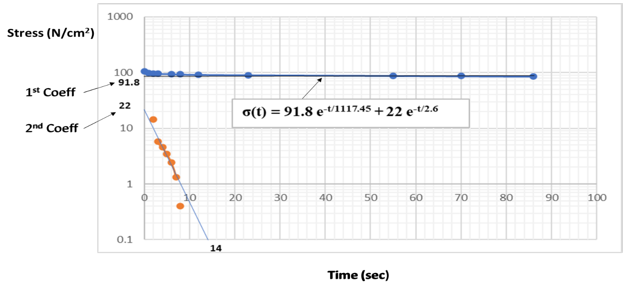
This study determined the stress relaxation behaviour of sweet potato (Ipomoea batatas L.) tissue samples (n=9) having 1 cm3 volume each, taken at an approximate mid-length of a transverse section of three randomly selected root tubers locally grown in Trinidad and Tobago. A Baoshishan Digital Force Gauge HP-500N with manual force test stand and digital displacement scale was utilised for testing. A flat disc indenter, having a 15 mm diameter was used to apply a constant deformation of approximately 3.14 mm (s=0.12 mm) at a rate of loading of approximately 0.5 mm/sec. Force decay was digitally recorded over an approximate period of two minutes. The method of successive residuals was used to determine stress relaxation times (Trel) for tissue samples. The stress relaxation rheological model for sweet potato tissue was determined to be a two-term exponential equation, where σ(t) = 94.12 e-t/1877.25 + 24.78 e-t/4.07 (N/cm2). Theoretical apparent Modulus of Elasticity and Shear Modulus (Poisson’s Ratio, ν=0.43) was calculated to be 373.9 N/cm2 and 91.42 N/cm2 respectively. Thin slices of approximately 1mm of each root tuber were prepared for dehydration at 150°F for 12 hours in a convection dryer. Moisture content was determined to be 69.23% by weight.
Downloads
Published
Issue
Section
License
Copyright (c) 2022 Caribbean Journal of Multidisciplinary Studies

This work is licensed under a Creative Commons Attribution-NonCommercial 4.0 International License.