Authors
-
Solange Kelly
The University of Trinidad and Tobago
-
Ejae John
The University of Trinidad and Tobago
-
Samantha Chadee
The University of Trinidad and Tobago
Keywords:
IPCC 2006 model, landfill gas, non-engineered landfill, tropical country, climate change, Trinidad & Tobago, Caribbean, Small Island Developing State
Abstract
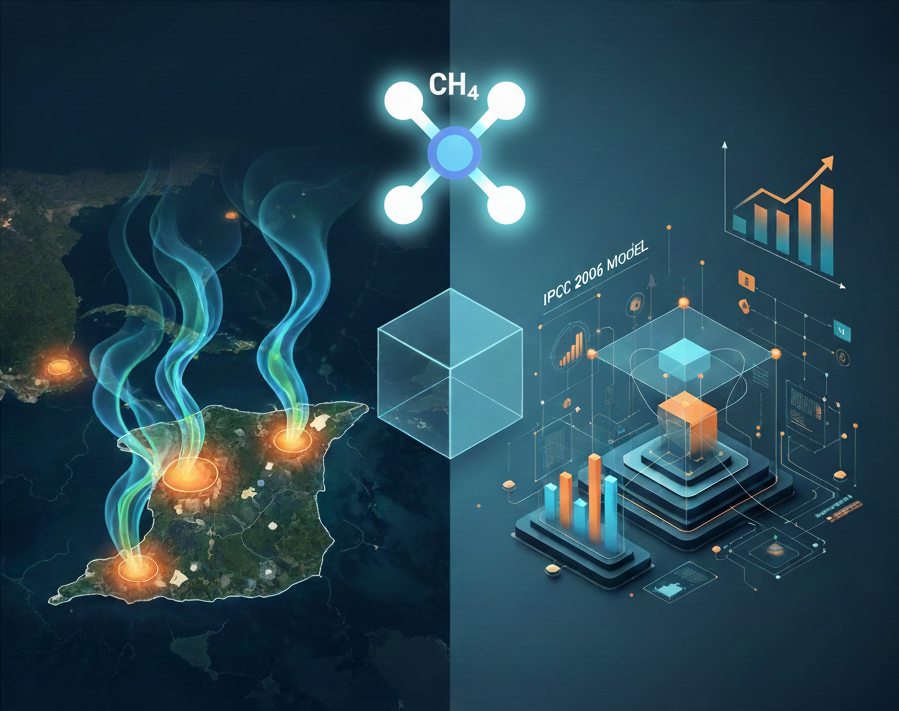
Air pollutant emissions from landfills contribute to climate change through high concentrations of greenhouse gases and are a human health concern through their role in exacerbating non-communicable diseases. It is important that solutions are found to mitigate the release of landfill gases into the atmosphere, such as conversion into useful products. However, first the quantity of landfill gas (LFG) available must be estimated. In Trinidad and Tobago (T&T), 1800 tonnes of waste is generated daily from the country’s three major landfill sites: Beetham, Forres Park, and Guanapo. In this study, the available methane from these landfills is quantified.
A Tier 2 approach using The Intergovernmental Panel on Climate Change 2006 Model (IPCC 2006) was used to estimate the quantity of methane gas being released by the landfills in T&T. Using this method, it is estimated that the methane generation at each of the three landfills is as follows: Guanapo 2292.83 m3/h; Forres Park 3706.89 m3/h and; Beetham 5166.37 m3/h. An error adjustment of +/- 17% was applied, followed by a collection efficiency of 40%. The estimated available methane directly affects any technoeconomic analysis regarding potential uses of the landfill gas. Thus, accurately quantifying the potential amount of methane produced, as presented in this publication, is the first step towards the goal of utilising the landfill gas of T&T in a safe, sustainable, and economic manner.
Author Biographies
Solange Kelly, The University of Trinidad and Tobago
Dr Solange Kelly has over twenty years of postgraduate research and industrial experience in process systems optimization, exergy analysis, and the harnessing of energy from waste and the ocean. She worked as a Research Assistant at the University of the West Indies (UWI) for two years, where she conducted research in the exergy analysis of absorption chillers and power plant systems. She also studied and served as a Research Assistant at the Technical University of Berlin, where she conducted research on the optimization of thermal power plant systems using advanced energy optimization techniques. In 2006, she was recognised by the Advanced Energy Systems Division of ASME for her work on splitting exergy destruction into its endogenous and exogenous parts. Dr Kelly is currently an Associate Professor at the University of Trinidad and Tobago (UTT), where she also serves as the Assistant Vice President for Undergraduate Studies. Her current research focuses on thermal system optimization, Ocean Thermal Energy Conversion (OTEC) systems, and the conversion of waste into useful energy.
Ejae John, The University of Trinidad and Tobago
Dr Ejae John is an Associate Professor of Process Engineering at the University of Trinidad and Tobago (UTT). She is also the Programme Leader for Process Engineering. She earned her PhD in Industrial Chemistry from the Georgia Institute of Technology, USA. Dr John brings a diverse background spanning the pharmaceutical, hydrocarbon, and specialty chemicals industries, as well as academia. She has contributed to a wide range of interdisciplinary research projects across fields such as chemistry, agricultural engineering, chemical engineering, energy engineering, environmental engineering, civil engineering, and utilities engineering. These collaborations—spanning academic, governmental, industrial, and mixed-sector teams—have focused on solving complex technical and environmental challenges. Her research interests include the development of environmentally benign and sustainable processes, products, and systems; process optimization; sustainability assessments; waste-to-energy technologies; and the characterisation, reduction, and reuse of waste.
Samantha Chadee, The University of Trinidad and Tobago
Dr Samantha Chadee is an environmental sustainability scientist, lecturer and consultant with over nine years of experience in higher education and applied research. Based at the University of Trinidad and Tobago (UTT) as an Assistant Professor, she conducts research and lectures in the areas of climate change and environmental pollution, environmental law and policy, data analysis and research methodology. Her work focuses on urban ecosystems, climate resilience, sustainable development and positive environmental behaviour. Dr Chadee has authored numerous publications and has presented her work at regional and international forums. She is actively engaged in national service through appointments on key environmental and sustainable development committees, including the National Council for Sustainable Development and the Management Advisory Committee for Environmentally Sensitive Areas. Passionate about bridging science and policy, Dr Chadee is committed to advancing holistic solutions to the complex challenges of environmental sustainability.